

Every school morning begins with the same quiet question in a parent’s mind: has my child boarded the bus, and will they reach the gate safely? A modern School Transport Management System answers that question before it is asked. VectraRide’s School Transport Management System (STMS) is a dedicated platform built to manage school commutes with precision ensuring every child’s journey is planned, monitored, and secure from the first pickup to the final drop-off.
School transport is not a scaled-down version of corporate transport. It carries a different risk profile, a stricter accountability standard, and a far more anxious audience. Balancing route logistics with total transparency for families calls for purpose-built school transport software — not a spreadsheet, a printed manifest and a phone tree. This guide covers how a school transport management system works, the features that matter most, and what to look for when you evaluate school bus management software for your institution.
What Is a School Transport Management System?
A School Transport Management System is a centralised platform that plans, allocates, tracks and reports on every school bus trip. It replaces the paper manifest, the printed route sheet and the informal parent WhatsApp group with a single source of truth shared by administrators, drivers and guardians.
At its core, the system does four things:
- Plans — builds efficient routes from student addresses, time slots and designated school zones.
- Allocates — assigns every student a confirmed seat on a specific bus with a specific driver.
Automated Route Planning and Student Allocation
Efficient school transport depends on intelligent grouping and accurate timing so that students reach school and home safely and on schedule. VectraRide automates the sequence end to end:
- Student information integration: The system holds detailed student profiles, including pickup and drop-off points, class timings and specific time-slot requirements.
- Time-slot synchronisation: Student requests are grouped into defined time slots to organise morning and afternoon shifts cleanly.
- Automatic route allocation: The allocation engine assigns each student to the most efficient trip based on their location and the designated school zone.
- Vehicle and driver pairing: Once the route is optimised, it is assigned to a specific bus and driver so every student has a confirmed seat for their shift before the day begins.
- Capacity enforcement: Seat limits are applied automatically, which means no bus is ever overloaded and no child is left off a manifest.
What used to take a coordinator several days at the start of each term now takes minutes, and it can be re-run whenever a new admission or address change comes in.
Real-Time GPS School Bus Tracking and Parent Transparency
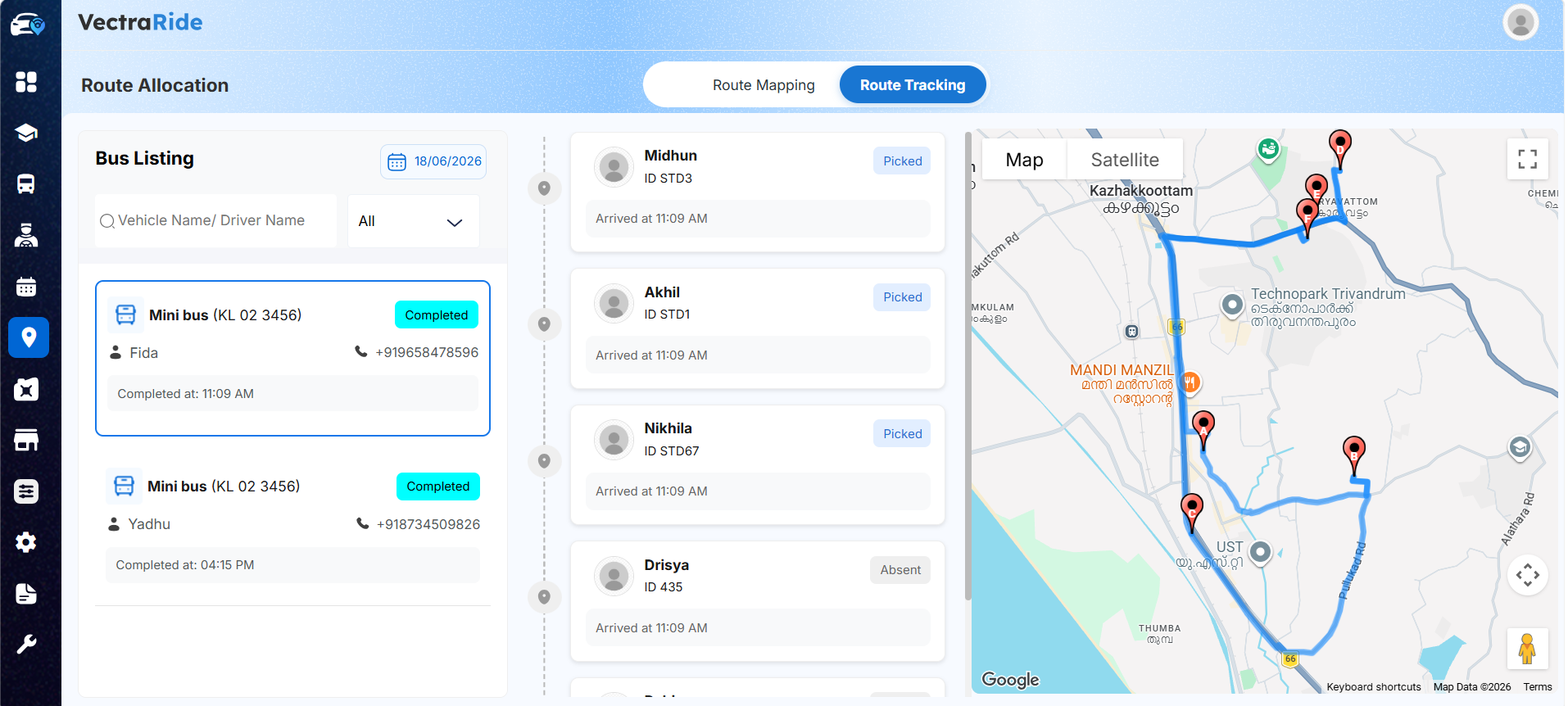
Transparency is the foundation of trust in school transport. A school bus tracking system makes sure parents are never left guessing about where their child is.
- Live route tracking. Continuous GPS oversight lets both administrators and parents see the bus’s exact position and progress along the route.
- Real-time status updates. Parents can see whether their child is “In Transit”, “Picked Up” or “Dropped Off” updated as it happens, not reported after the fact.
- Automated notifications. Approach alerts, delay notices and arrival confirmations are pushed to the parent tracking app without any manual effort from school staff.
- Incident management. Administrators can log delays or breakdowns immediately and push a status update directly to affected parents in a single action.
The operational payoff is significant: schools that adopt GPS school bus tracking typically see a sharp drop in morning inquiry calls, because the information parents want is already on their phone.
- Purpose-built for students, not generic fleets: Time slots, school zones, guardian permissions and class timings should be first-class concepts, not workarounds.
- A genuine parent app: An SMS alert is not a parent tracking app. Look for live map tracking and per-student status.
- Automated allocation: If routes still have to be drawn manually, you have bought a map, not a system.
- Offline tolerance on the driver app: Buses pass through poor-coverage areas; the manifest must still work.
- Audit-ready records: Timestamped boarding data that can be exported when a question is raised weeks later.
- Compliance tracking built in: Document expiry alerts should be part of the platform, not a separate reminder list.
Conclusion
The right School Transport Management System turns school transportation from a complex daily challenge into a reliable, automated and transparent service. VectraRide’s STMS brings route planning, automated allocation, GPS school bus tracking, parent communication and compliance management into one platform so administrators spend less time firefighting and parents spend less time worrying.
Student safety is not a feature to be added later. It is the reason the system exists, and it should be visible in every trip the platform runs.