

A single unreported brake fault can pull a vehicle off the road for three days and a whole route out of service for a week. In most fleets the problem is not that drivers fail to spot faults — they spot them first, every single day. The problem is what happens next: a phone call to a supervisor who is already on another call, a note scribbled in a logbook, a message that scrolls out of view before anyone acts on it. A Fleet Maintenance Management System closes that gap by turning every driver observation into a structured record the workshop can actually act on. VectraRide does this through its Maintenance Pipeline: direct mobile-to-web reporting that converts driver-logged road incidents into trackable maintenance work orders instantly, with no re-keying and nothing lost between the roadside and the garage.
What Is a Fleet Maintenance Management System?
A Fleet Maintenance Management System is the part of a wider fleet management software platform that plans, records and tracks everything done to keep vehicles roadworthy. It sits between the people who notice problems — drivers, supervisors, inspectors — and the people who fix them.
A complete system handles five things:
- Fault capture: structured reporting of breakdowns, damage, warning lights and roadside incidents, ideally from the vehicle itself.
- Work order management: converting a report into an assignable job with an owner, a priority and a due date.
- Service scheduling: planned servicing triggered by odometer readings, engine hours or calendar intervals.
- Cost capture: parts, labour and third-party garage invoices recorded against the specific vehicle.
- Vehicle history: a permanent, timestamped record of every fault and every repair for that asset.
Generic maintenance tools were built for machines that stay in one building. Fleet assets move, break down far from the depot, and are operated by someone who is not a technician. That is why a purpose-built Vehicle Maintenance Management System starts with the driver’s phone rather than the workshop desk.
Why Manual Breakdown Reporting Costs More Than Fleets Realise
Most transport operators still run maintenance reporting on calls, paper and chat groups. It feels cheap because nobody invoices for it. The real cost shows up elsewhere:
- Reporting delay. A fault noticed at 7 a.m. reaches the workshop at 6 p.m. when the driver returns — eleven hours in which the vehicle kept running on it.
- Information loss. Verbal reports lose the detail that matters: which warning light, at what speed, on which stretch of road.
- No ownership. A message in a group chat belongs to nobody. A work order belongs to a named person with a deadline.
- No history. When the same clutch fails for the third time in eight months, nothing in the paperwork reveals the pattern.
- No cost visibility. Without per-vehicle cost capture, there is no evidence base for deciding when to repair and when to replace.
Effective vehicle breakdown management is not about fixing things faster. It is about shortening the distance between the moment a fault is noticed and the moment it becomes somebody’s job.
How a Fleet Maintenance Management System Turns Driver Reports Into Work Orders
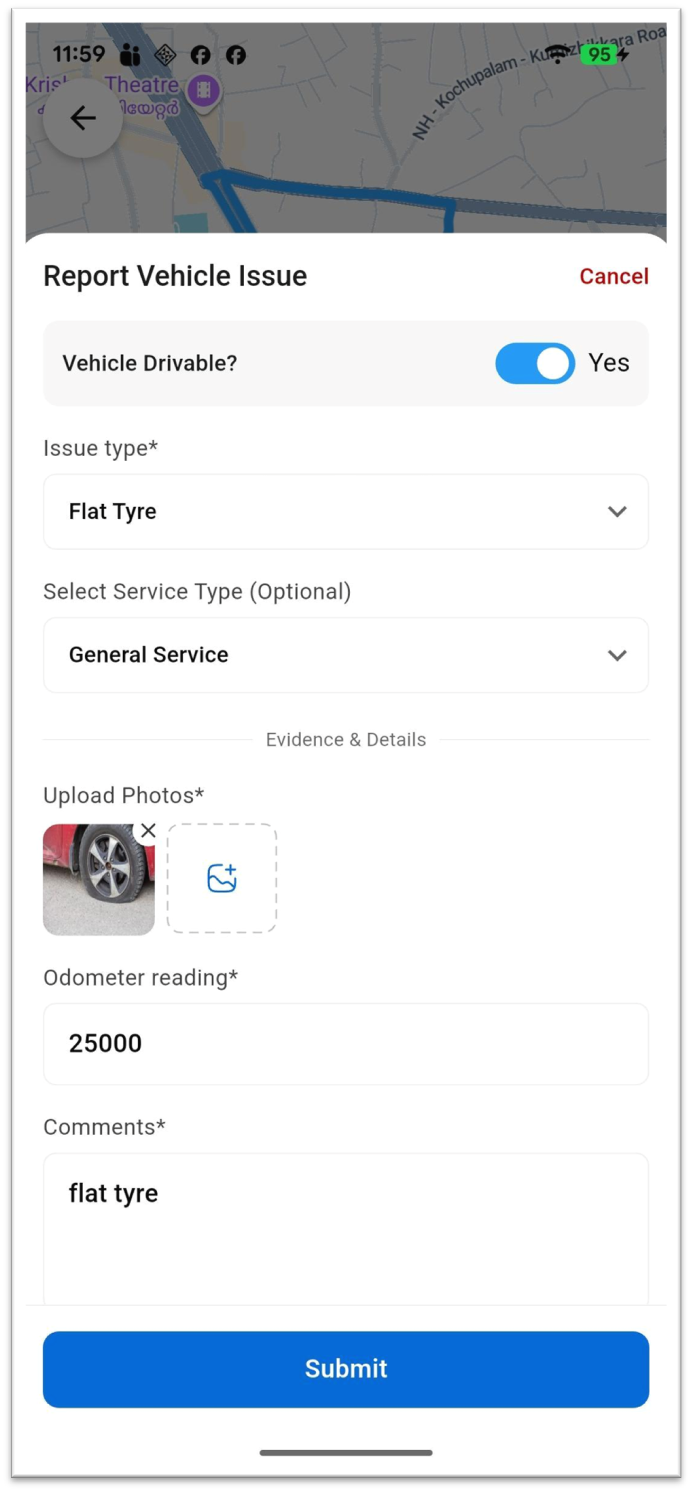
The Maintenance Pipeline in VectraRide’s Fleet Maintenance Management System is a single unbroken flow that turns every driver report into a work order in four stages, with no manual handoffs.
1. The driver logs the incident from the mobile app
The driver opens the driver incident reporting app, selects the vehicle already assigned to that trip, picks an incident type, adds a short description and attaches photos. Location and timestamp are captured automatically. Because the vehicle, driver and trip are already known to the system, there is nothing to type twice and no way to file a report against the wrong asset.
2. The report reaches the web dashboard immediately
The moment the driver submits, the report appears on the fleet manager’s dashboard — not in an inbox, not in a chat group, but as a live item in the maintenance queue with a severity flag. Critical reports can trigger alerts so a safety-related fault is never queued behind a scratched wing mirror.
3. The system converts the report into a trackable work order
This is the step manual processes skip. The report becomes a work order with a unique reference, a priority, an assigned technician or external garage, an expected completion date and a status. Maintenance work order software matters here because status is what makes the job visible: Reported, Acknowledged, In Progress, Awaiting Parts, Completed. Nothing sits in an undefined state where each party assumes the other is handling it.
4. Closure, cost capture and permanent vehicle history
On closure the technician records the work done, parts consumed, labour hours and cost. The work order is then locked into the vehicle’s service history. Six months later, when the same fault code returns, the whole chain — the original photo, the diagnosis, the parts fitted, the technician who signed it off — is one click away.
Core Features of VectraRide’s Fleet Maintenance Management System
VectraRide was built for operators running real fleets — taxi and cab companies, corporate shuttles, school buses and mixed logistics fleets. Its maintenance module includes:
- Mobile-to-web incident reporting with photo evidence, GPS location and automatic vehicle association.
- Automatic work order generation from any submitted incident, with configurable priority rules.
- Assignment and escalation to in-house technicians or external garages, with overdue-job alerts.
- Preventive maintenance scheduling driven by odometer readings, engine hours or fixed calendar intervals.
- Per-vehicle cost tracking covering parts, labour and third-party invoices, reportable by vehicle, depot or period.
- Downtime reporting showing which vehicles are out of service, for how long, and why.
- Complete audit trail so every status change carries a user and a timestamp.
Because maintenance shares the same data layer as dispatch and billing, a vehicle marked out of service is automatically excluded from allocation — the kind of behaviour a standalone maintenance tool bolted onto a fleet management system can never reliably deliver.
Preventive vs. Reactive Fleet Maintenance
Reactive fleet maintenance responds to failures. Preventive fleet maintenance stops them happening. Every fleet needs both, and the ratio between them is one of the clearest indicators of operational maturity.
Preventive maintenance software schedules work before failure: oil changes at set mileage, brake inspections every quarter, tyre rotations by engine hours. It is cheaper per job and, more importantly, it is planned — the vehicle is off the road at a time you chose rather than a time the road chose for you.
Reactive work will never disappear. Potholes, kerb strikes and third-party collisions are not schedulable. What a good system does is make reactive work fast and evidence-rich, and feed its data back into the preventive schedule. Three unplanned suspension jobs on the same route is not bad luck; it is a routing problem or a road-condition problem, and the maintenance record is where it becomes visible.
Business Benefits of Automated Fleet Maintenance Work Orders
When every driver report becomes a tracked job, the gains show up across operations, finance and safety at the same time:
- Less unplanned downtime. Faults reported in minutes rather than at end of shift are addressed before they escalate.
- Lower repair costs. Early intervention on a small fault is consistently cheaper than a roadside recovery and a major repair.
- Higher vehicle availability. Planned servicing scheduled around demand keeps more of the fleet earning during peak hours.
- Better vendor negotiation. Per-vehicle and per-garage cost history turns supplier discussions into evidence-based conversations.
- Stronger safety posture. A timestamped record showing every reported fault was actioned is exactly what an insurer or investigator asks for.
- Sharper replacement decisions. Lifetime maintenance cost per vehicle shows precisely when an asset has stopped paying its way.
How Fleet Maintenance Connects to Compliance, Dispatch and Billing
Fleet maintenance in isolation solves half the problem. In VectraRide it is wired into the rest of the platform. Fleet compliance management tracks insurance, fitness certificate and permit expiry alongside service records, so a vehicle is only cleared for allocation when it is both mechanically sound and legally compliant. The auto-allocation engine reads vehicle status directly, which means a bus in the workshop never appears in tomorrow’s route plan — the same principle that makes VectraRide’s cab management system dependable at scale.
The pattern repeats across use cases. An employee transportation management system needs guaranteed vehicle availability for shift starts. A school transport management system cannot put a bus with an open safety fault on a route carrying children. Operators handling corporate transportation contracts need maintenance costs attributable to the right client and the right billing period. One data layer serves all three.
Most breakdowns don’t start on the road. They start with a fault a driver noticed and couldn’t report properly. A Fleet Maintenance Management System closes that gap. Every observation becomes a work order with an owner, a priority and a deadline, and every completed repair becomes part of the vehicle’s permanent history.
With VectraRide, drivers report incidents from the mobile app and managers see them on the dashboard right away. Maintenance work orders are created automatically. Preventive schedules, cost tracking and fleet compliance management run on the same platform as dispatch and billing, so a vehicle with an open fault never reaches a route plan. The result is less unplanned downtime, lower repair costs and a safety record you can defend.
If your fleet still relies on phone calls, logbooks and chat groups for vehicle breakdown management, it’s time to move that pipeline online. Request a Demo to see VectraRide’s Fleet Maintenance Management System handle a live incident from report to repair.