

A vehicle that fails on the road costs far more than the repair bill. An emergency callout, an idle driver, a missed pickup and a last-minute replacement vehicle all land on the same day, and none of them were budgeted for. Most of those failures were predictable, which is why a fleet management system has become core infrastructure for transport operators rather than an optional upgrade. By holding vehicle records, service schedules, document expiry dates and driver-reported faults in one place, VectraRide gives fleet teams the visibility to fix problems before they reach the roadside.
This article works through a scenario most transport operators will recognise — a corporate cab breaking down mid-route on a Tuesday morning — and shows how VectraRide turns that kind of disruption into a scheduled, costed maintenance task instead of an operational emergency.
What Is a Fleet Management System?
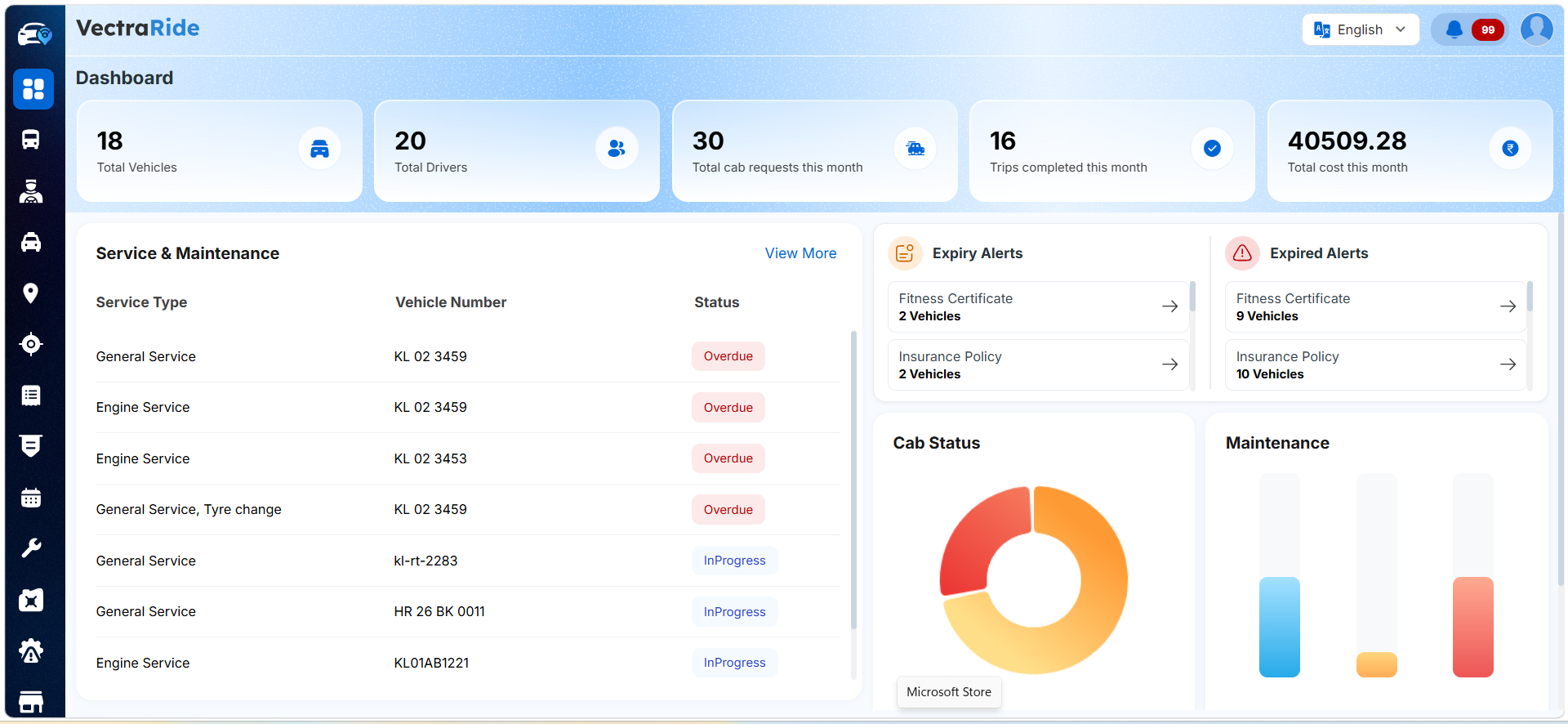
A fleet management system is a centralised software platform that gives a transport operator one live view of every vehicle it runs: where the vehicle is, what condition it is in, when it is next due for service, and whether its documentation is currently valid.
Modern fleet management software consolidates functions that were historically spread across paper files, workshop notebooks and disconnected spreadsheets:
• Vehicle and driver master records in a single database
• Preventive maintenance scheduling with full service history per vehicle
• Document and expiry tracking for insurance, fitness, permits and pollution certificates
• Incident reporting submitted by drivers from the field
• Work order creation, assignment and repair tracking
• GPS-based vehicle tracking and trip logs
• Utilisation, downtime and cost reporting across the fleet
The value does not sit in any one of those features. It sits in the fact that they share the same underlying data. When a driver reports a fault, the workshop, the dispatcher and the transport manager all see it at the same moment — and that is the practical difference between vehicle fleet management that anticipates problems and vehicle fleet management that reacts to them.
The Challenge: Reactive Fleet Maintenance
Reactive maintenance means repairing a vehicle only after it has already failed. It appears cheaper on paper because nothing is spent until something breaks. In operation, it is consistently the most expensive way to run a fleet.
Consider a corporate transport provider running 50 cabs with no central system, relying on manual logbooks and driver recollection to keep vehicles roadworthy.
The incident. At 8:00 AM on a Tuesday, a cab assigned to an executive airport drop-off fails on a highway. The cause is a worn alternator that had been showing symptoms for several days — noticed by the driver, mentioned to nobody, recorded nowhere.
What follows:
• Direct cost. An emergency roadside callout plus a same-day replacement vehicle costs several times what a planned alternator change would have cost during scheduled downtime.
• Service failure. The passenger is delayed by two hours and misses a flight. The damage lands on the client relationship, not on the workshop.
• Wasted labour. The driver spends half a shift stationary on the roadside, paid and unproductive.
• Compliance exposure. The post-incident review reveals the vehicle’s fitness certificate lapsed two days earlier, which means the trip should never have been dispatched at all.
Every one of those outcomes was visible in advance. Without a system to surface them, none of them was actionable. That is the structural weakness of manual transport fleet management: the information exists, but it lives in a driver’s memory, a paper file and a spreadsheet nobody opened this week.
How VectraRide’s Fleet Management System Solves the Problem
VectraRide replaces recollection with recorded data. Three capabilities address the Tuesday-morning scenario directly.
Automated Vehicle Document & Compliance Tracking
The expired-certificate element of the story is the easiest to eliminate entirely.
Administrators upload every vehicle document — insurance, fitness, permit, pollution certificate — against the vehicle record along with its expiry date. The platform then handles fleet compliance management continuously rather than at audit time:
• Automated reminders are issued weeks ahead of each expiry date, leaving procurement enough time to act.
• Vehicles with lapsed documentation are flagged as non-compliant on the fleet listing.
• Managers can see the compliance state of the entire fleet before allocating trips, not after an incident.
The outcome is straightforward: a vehicle with invalid paperwork becomes visible as a problem while it is still parked in the yard.
Incident Reporting & Digital Work Orders
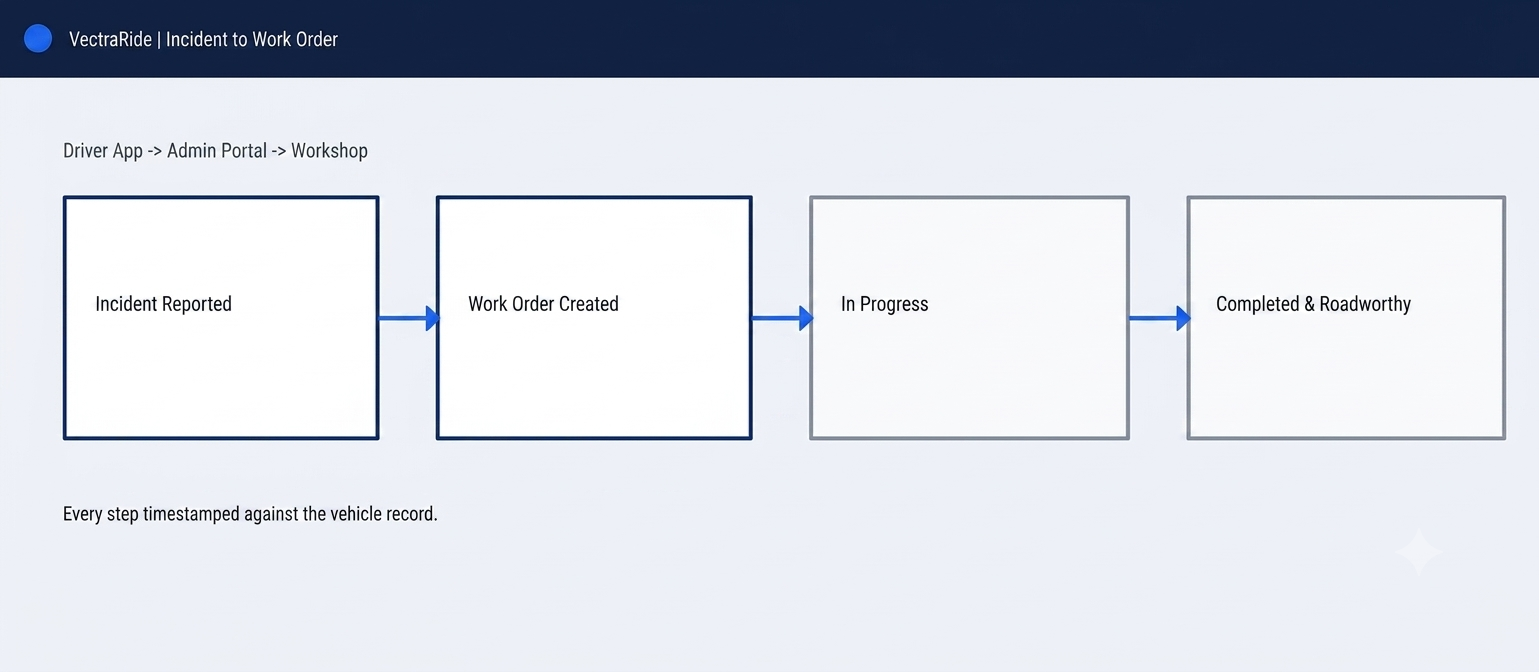
The wider gap in most operations is between a driver noticing something and a technician acting on it. VectraRide closes that gap with a defined fleet maintenance management pipeline:
- Report from the cab. Using the driver app, a driver logs an incident — an unfamiliar noise, a warning light, a change in handling — the moment they notice it, with notes and photographs attached to the vehicle record.
- Convert to a work order. The report appears on the admin incident listing in real time. From that row, an administrator raises a work order directly, with no re-entry of details and no chasing the driver for clarification.
- Track through to closure. The work order moves through Pending, In Progress and Completed, building a verifiable service history against the vehicle.
This is where fleet maintenance software earns its cost. A worn alternator reported on Friday and repaired over the weekend is routine vehicle maintenance management. The same fault left unrecorded until Tuesday morning is an incident with a client attached to it. The mechanical event is identical — only the recording differs.
Fleet Analytics & Vehicle Utilization
Once maintenance data accumulates, it becomes useful for planning rather than only for record-keeping. VectraRide’s fleet analytics give transport managers visibility into:
- Which vehicles are currently active, in the workshop, or sitting idle
- Utilisation across the fleet, exposing vehicles that are over-worked as well as those barely used
- Maintenance cost and repair frequency by vehicle, which identifies assets that consistently cost more than they return
- Downtime patterns that point to a supplier, a route or a driver rather than to the vehicle itself
A vehicle that keeps reappearing in the workshop is not only a maintenance problem — it is a fleet composition decision, and it needs data behind it. Combined with vehicle tracking and trip logs, utilisation reporting also shows whether a vehicle is genuinely needed at its current capacity or whether the same service could be delivered with fewer assets.
Reactive vs. Preventive Fleet Maintenance
The distinction between the two approaches comes down to when the repair is triggered, and everything that follows from that timing.
Under a reactive model, failure itself is the trigger. The vehicle stops, and only then does work begin — at emergency callout rates, with whatever parts are available that day, and with a trip already cancelled or re-dispatched. Downtime is unplanned and lands mid-route, usually during peak hours. Compliance gaps surface during audits or after incidents rather than before dispatch. Records amount to a folder of invoices collected after the fact, which makes the maintenance budget unpredictable from one month to the next.
Preventive fleet maintenance moves the trigger earlier — to a scheduled service interval or a symptom a driver has reported. The work is quoted and booked in advance, the vehicle comes off the road outside service hours, and replacement cover is arranged before any passenger is affected. Documentation is flagged while the vehicle is still parked. Each asset carries a complete service history, and maintenance becomes a forecastable line item rather than a recurring surprise.
Preventive maintenance does not eliminate repairs — vehicles wear out either way. What it does is convert an unpredictable operational risk into a scheduled, costed task that a transport manager can plan around.
The Results: From Reactive Maintenance to Proactive Fleet Management
Operators moving from manual logs to a structured fleet management system typically see change concentrated in four areas.
- Fewer roadside breakdowns. Symptoms reported through the driver app get resolved during scheduled downtime rather than escalating into failures on a live trip.
- No compliance penalties. Automated expiry tracking keeps every dispatched vehicle legally documented and insured, removing fines and audit findings.
- Shorter repair cycles. A digital work order trail removes the back-and-forth between drivers, dispatch and the workshop, returning vehicles to service faster.
- Better capital decisions. Cost-per-vehicle data supports evidence-based calls on when to repair, retain or replace an asset.
Why Choose VectraRide for Fleet Management?
Plenty of platforms will show a vehicle moving on a map. Fewer are built around how a transport business actually runs day to day.
VectraRide is designed for that operational logic — for the reality that a compliance expiry, a driver’s incident report, a workshop job and a trip allocation are all the same problem viewed from four different desks. It does not only tell you where a vehicle is. It tells you whether that vehicle is compliant, mechanically sound and cleared to run its next trip.
For operators running corporate transport, school routes or mixed commercial fleets, that distinction is what separates vehicle maintenance software that records history from a system that prevents the next breakdown.
| Stop firefighting your fleet.
See how VectraRide’s fleet management system handles preventive maintenance, document compliance and vehicle tracking from one platform. Book a walkthrough using your own fleet size and vehicle mix, and we will show you exactly where the breakdowns are being missed today. |