

Managing transportation operations across corporate shuttles, school buses, or commercial cab fleets shouldn’t mean constantly juggling a dozen disconnected spreadsheets. In many organizations, dispatchers, fleet managers, and HR administrators waste countless hours manually cross-referencing vehicle logs, driver schedules, employee rosters, and fuel receipts.
This fragmented, paper-heavy approach doesn’t just create administrative friction—it leaves organizations vulnerable to compliance risks, unmonitored overtime costs, inefficient route planning, and delayed safety responses. When data lives in siloes, identifying idle vehicles or rogue vendor billing becomes nearly impossible until the end-of-month financial audit.
The real problem is not effort — it is architecture. A spreadsheet cannot alert a supervisor when a vehicle’s insurance is about to lapse, reconcile a vendor invoice against the distance actually travelled, or show which of this morning’s trips are running late. Every one of those answers has to be assembled by hand, usually after the fact, which is why so much transportation operations management still happens reactively instead of proactively.
What Is Transportation Management Software?
A transportation management system is a single platform that plans, allocates, tracks, and reports on every journey an organization runs — across owned vehicles, contracted vendors, drivers, and the employees or students who travel each day. Where fleet management software concentrates on the vehicles themselves — maintenance, fuel, documents, utilisation — a transport platform also has to account for the people and trips those vehicles exist to serve.
Transportation management software replaces the spreadsheet stack with one live operational record. Rosters, routes, shift timings, driver credentials, vehicle documents, GPS positions, and fare rules all sit in the same system, so a change in one place is reflected everywhere else. Instead of running separate tools for booking, fleet tracking software, and invoicing, administrators work from a single transportation management dashboard.
That consolidation is what makes genuine automation possible. Once operational data is unified and current, the platform can group riders, allocate vehicles, flag policy breaches, and calculate fares without anyone re-entering a thing.
What Is the VectraRide Admin Dashboard?
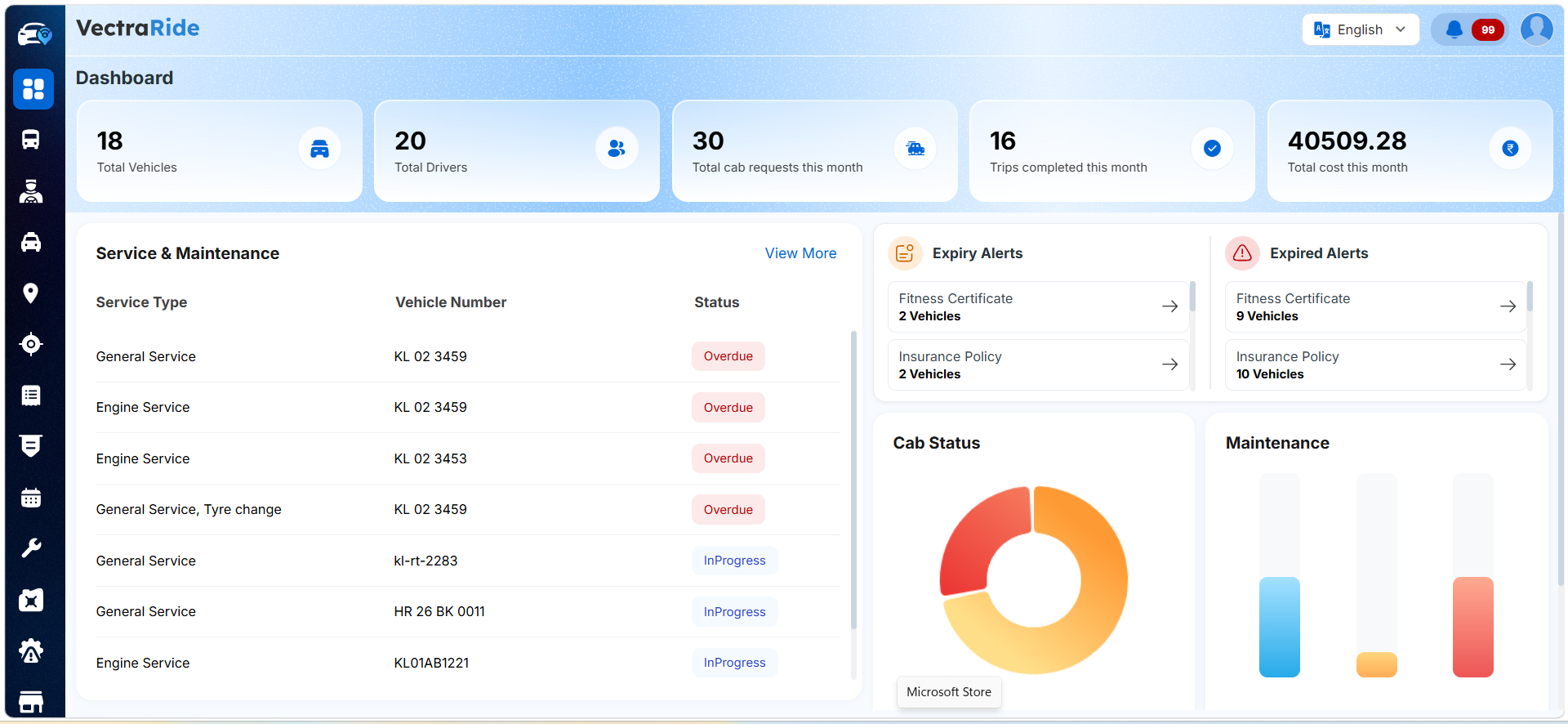
The VectraRide Admin Dashboard serves as the command center for your entire transportation ecosystem. Rather than switching between disparate software tools, tracking apps, and static Excel sheets, your management team gains end-to-end, real-time visibility into every asset, route, driver, and trip from a single, unified interface.
By combining real-time GPS telemetry, intelligent shift management, driver credentials, and automated billing, the dashboard turns complex operational data into actionable, zero-friction workflows.
Key Capabilities of the Centralized Dashboard
- Complete Fleet & Operational Visibility: Monitor active vehicles, live trip progression, driver assignments, and vendor deployment in real time across interactive maps and live status queues.
- Automated Policy & Compliance Enforcement: Establish customized organizational guidelines—such as maximum speed limits, mandatory driver rest breaks, approved trip windows, and localized geographical fences—and automatically flag or prevent non-compliant activities.
- Proactive Fleet Maintenance Management: Schedule preventive servicing by odometer reading or due date, convert driver-reported road incidents into trackable work orders, and monitor vehicle downtime so ageing assets are retired on evidence rather than instinct.
- Document Expiry & Compliance Alerts: Hold insurance, fitness, permit, and licence details against every vehicle and driver, with automated expiry reminders — turning fleet compliance management from a monthly scramble into a background process.
- Data-Driven Cost Optimization: Identify underutilized assets, curb unauthorized trip usage, reduce empty deadhead miles, and cut overall fuel costs through automated intelligent routing.
- Vendor Performance & Audit-Ready Invoicing: Track third-party cab vendors against service-level agreements (SLAs), verify exact trip mileages, and ensure automated, audit-ready fare calculations without disputes.
Seamless Management Across Specialized Transportation Modules
While different sectors face distinct mobility challenges, the VectraRide Admin Dashboard adapts to serve corporate, educational, and commercial fleet environments within a unified framework.
In Corporate Cab Management (CMS), the dashboard optimizes employee commuting by automatically grouping riders based on location proximity and shift timings. It enforces corporate travel policies in real time, tracks active trips across an interactive live map, and automates vendor fare calculations and monthly invoicing to eliminate billing discrepancies — the operational core of effective corporate transportation management.
For School Transport Management (STMS), the priority shifts to absolute student safety and accountability. The system automates complex student-to-vehicle route allocations upon uploading student lists, synchronizes morning and evening shifts, and provides administrators and parents with live safety tracking and instant exception alerts. Because school transportation management answers to families as well as auditors, every trip leaves a verifiable record.
Meanwhile, in Fleet Logistics & Maintenance (FMS), the platform focuses on overall fleet health and asset longevity. Delivered as an integrated fleet management system, it provides proactive maintenance scheduling, real-time fuel consumption monitoring, driver documentation compliance, and deep telemetry analytics — ensuring every vehicle remains cost-efficient, compliant, and operational.
How Transportation Management Software Enables Smarter Decisions
Making smarter operational decisions requires data that is always accurate, aggregated, and available at your fingertips. By consolidating real-time location metrics with automated policy engines, the VectraRide Admin Dashboard empowers transport administrators to eliminate administrative overhead, guarantee compliance, and deliver a seamless travel experience for every rider.
In practice, that means the numbers managers are asked for at review meetings are already waiting for them: cost per trip and cost per rider, vehicle utilisation against available capacity, on-time performance by route, empty-mile percentage, overtime patterns, and vendor SLA adherence. Comparing one month against the next stops being a data-collection exercise and becomes actual analysis.
It also changes the character of transportation compliance. Instead of proving after an incident that policy was followed, administrators can demonstrate continuously that it is being followed — with time-stamped trip records, driver document histories, speed and geofence exceptions, and maintenance logs available on demand. For safety teams and finance teams alike, an auditable trail is worth more than a well-formatted report.
Choosing a Transportation Management Solution That Scales
Centralization only pays off if the platform can grow with the operation it runs. When evaluating any transportation management solution, it is worth pressure-testing five things before you commit:
- One source of truth. Rosters, vehicles, drivers, vendors, and billing should share the same underlying records rather than syncing between modules that occasionally disagree.
- Configurable rules, not hard-coded ones. Shift windows, speed thresholds, geofences, and escalation paths differ by organization, and an administrator should be able to change them without a developer.
- Compliance in the core workflow. Document tracking, expiry alerts, and maintenance histories belong inside the daily process, not in a separate register that someone remembers to update.
- Mobile parity. Drivers, employees, and parents need the same live information the control room sees — otherwise the phone calls simply move elsewhere.
- Transparent, versioned billing. A fare change must never rewrite historical invoices. Dependable fleet operations management rests on financial records you can still defend months later.
Whether you are coordinating employee transportation across multiple shifts, running a school fleet accountable to hundreds of families, or maintaining vehicles for a commercial operator, the direction of travel is the same: away from spreadsheets, and toward a single operational picture that everyone works from.
| Ready to Take Control of Your Transportation Operations?
Stop relying on fragmented spreadsheets and manual tracking. See how VectraRide can streamline your fleet management, strengthen compliance, and lower operational costs. Get a demo today: Book your VectraRide demo |